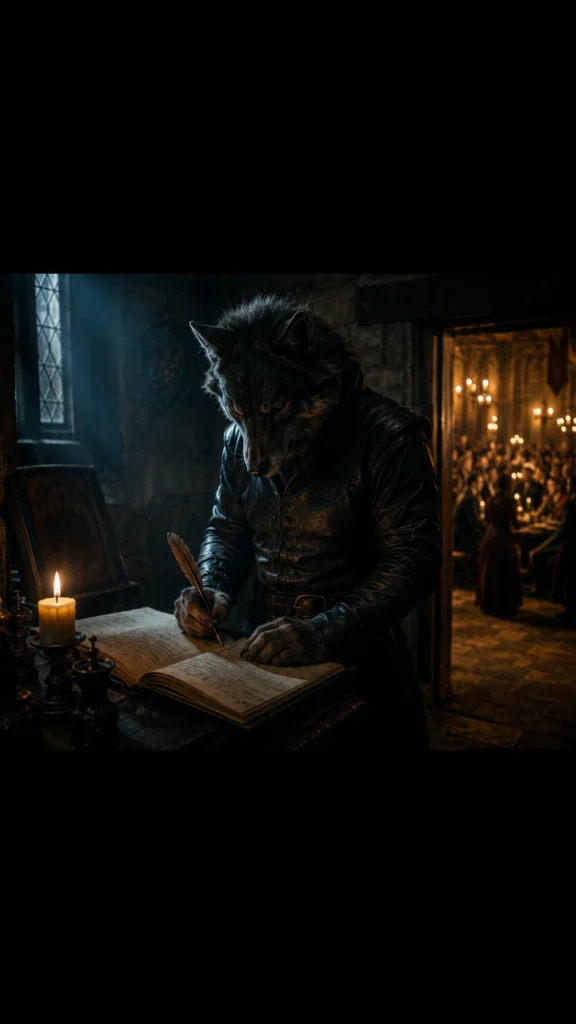
The middle rank runs the pack and never gets a story. Here’s the logic behind the erasure — and five ways to put betas back at the center.
So What Is a Beta Werewolf, Actually?
A beta werewolf is the middle rank of the shifter hierarchy: below the alpha, above the omega, and depending on which world you’ve wandered into, either a specific job or a vast unremarkable majority.
In most werewolf romance, the beta is the alpha’s second. He runs the guard, keeps the schedule, delivers the bad news, and is the only person in the Citadel permitted to tell the king he’s being an idiot.
In omegaverse specifically, beta is usually the presenting designation that isn’t the other two: no heat, no rut, muted scent or none at all, sometimes written as infertile, generally described as the rank that gets to have a normal life.
That’s the answer. It takes four sentences, which is roughly four sentences more than most stories give it.
What I want to talk about is what happens after that definition. Read enough of this genre and you start noticing that betas get defined in chapter one and then quietly stop existing.
Nobody Actually Agrees What a Beta Is
Alpha is stable. Omega is stable. You can move between authors, platforms, decades, and continents and the meaning survives the trip. Beta doesn’t.
In one world it’s a rank, the second-in-command with a specific chair at a specific table. In the next it’s a census category covering eighty percent of the population. In a third it’s an outcome: what you are if you present as neither. Sometimes betas are the calm ones, sometimes the sterile ones, sometimes just the ones the narrative isn’t about.
That inconsistency comes from how the rank is built. Beta is a residual category, defined by absence rather than content. Alphas have something. Omegas have something. Betas are what’s left when you’ve finished handing out the interesting biology.
A category defined by what it lacks is very, very easy to delete. You can’t accidentally forget to write the rank with the heat cycle. You can absolutely forget to write the rank whose defining trait is not having one.
And Then They Vanish
The worldbuilding paragraph arrives early: here are the alphas, here are the omegas, and here are the betas, who make up most of the pack. Sometimes there’s a nice line about how betas are the backbone of pack life. It’s warm and egalitarian, and it gestures at a whole society. Then the story starts and the society evaporates.
Enormous stretches of this genre run functionally alpha/omega only. The love interest is an alpha. The protagonist is an omega. The rival is an alpha. The confidante is an omega. The betas who supposedly make up the majority of every pack in existence appear as unnamed guards, a healer with two lines, and a man who opens a door.
Where there is a named beta, he is almost always the alpha’s second. He exists to be loyal, to be competent offscreen, and to be gently sidelined the moment the mate plot starts moving. He gets an arc in roughly the same way a doorframe gets an arc.
Fandom knows this and jokes about it constantly. What I’ve never seen is anyone explain why it happens, and I think the obvious explanation is wrong.
“Betas Are Boring” Doesn’t Hold up
The standard answer is that betas are narratively dull. No heat, no rut, no bond-fever, no fangs at the throat, so nothing to write about. I’d believe that if betas were actually powerless. They aren’t.
The beta runs the pack, and not ceremonially. He holds the roster, the rotation, the grain count, the guard schedule, and the record of who owes whom what. When a pack functions, it functions because a beta is doing the administrative labor of governance while the alpha does the part that looks like governance from a distance.
I’ve made this argument before without noticing I was making it. In the piece about where omega stigma comes from, I ran through who benefits from keeping the hierarchy intact: alphas enforce it, elders bless it, gammas need it, and betas administrate it. That was a throwaway clause, and it’s been bothering me since, because it means the genre’s most institutionally powerful non-alpha role is also its least-written one.
“Nothing to write about” can’t explain a character who holds the keys to everything. The real reason has less to do with betas than with what this genre runs on.
The Mechanism
Omegaverse presents itself as a social hierarchy. Underneath, it’s a compulsion engine.
Look at what the machinery is for. Heats and ruts create urgency nobody chose. Scent creates recognition nobody consented to. Knotting creates a physical commitment that outlasts the decision to make it. The mate bond turns love into a diagnosis: you don’t fall, you’re identified. Every mechanism in the genre’s toolkit exists to manufacture desire the character didn’t agree to and can’t decline.
That’s the appeal, and nobody’s confused about why it works.
Now notice which rank the engine can’t touch. No heat means no clock. No scent means no involuntary recognition. No bond-fever means no biological override. In a genre where plot comes from imperative, where the question is always what is being done to you and how long you can hold out, the beta is the one character the machine has no grip on.
Betas can’t be compelled, so they don’t generate plot. A story built on compulsion has no idea what to do with someone standing outside it, in full possession of their own judgment, making decisions for ordinary reasons.
Betas aren’t erased for being boring. They’re erased for being free.
What That Says About the Genre
A while back I wrote that the most controlling trope in the omegaverse isn’t the one everybody flags. Fated mates, the trope the genre loves most, is structurally more invasive than heats or claiming bites, because it doesn’t override your desires temporarily. It rewrites them and calls the new version authentic.
I didn’t see it at the time, but the beta is the counterweight to that argument. If fated mates work by rewriting desire, the beta is the one character in the pack whose desires can’t be rewritten. There’s no bond to install, no biology to route around, no revealed truth about who they were always meant to want. Whatever a beta wants, they picked.
And the genre has almost entirely removed that character.
I don’t think anyone decided this. Nobody held a meeting. It’s a thousand individual authors, over decades, each finding that the beta scene had nowhere to go and cutting it. Add up all those small reasonable cuts and you get a genre that systematically eliminated the only rank with autonomy. The erasure tells you what the machine selects for: the beta didn’t fit the engine, so the engine slowly spat him out.
The Objection
The other side deserves a real hearing.
Nobody came to omegaverse for autonomy. The compulsion is the product. Asking this genre to center the character immune to its central mechanism is a bit like asking a heist movie to focus on the guy who does the paperwork afterward. There’s no obligation here, and a genre that gave equal weight to every rank it invented would probably be a worse genre, not a fairer one.
Good betas also exist. Plenty of writers have found the beta scene and written it beautifully, usually by giving the beta something the alpha needs and can’t take by force.
So I wouldn’t call this a failure. It’s a choice, made a thousand times, mostly by people who didn’t notice they were choosing. That’s the useful part, because an unexamined default is just a setting nobody’s touched, and settings can be changed.
Five Ways to Put a Beta at the Center
These are premises rather than craft instructions. Each one takes the immunity that got betas cut and uses it as an engine instead of treating it as a deficiency.
- Immunity as clearance. A beta is the only one who can be in the room during a heat or a rut and be trusted there. That makes the immunity a security credential. The beta is the chaperone, the witness, the negotiator, the one who carries a message nobody else can be in the room to hear. Plenty of real courts ran on people whose value was that they couldn’t be compromised. Give that job to the one wolf who genuinely can’t be.
- Administration as detection. Conspiracies leave paperwork: requisitions that don’t balance, a rota with a name in the wrong place, a shipment logged twice. The beta is the only person who reads any of it, which makes them the only person who can catch it. They’re also the only person nobody thinks to hide it from, because nobody imagines the person keeping the ledger is reading the ledger.
- Consent as the romantic engine. A beta romance can’t run on a bond, because there’s nothing to install. The whole thing has to run on choice, on two people who could walk away at any point and keep deciding not to. That’s the version where “I choose you” isn’t quietly undercut by the reveal that biology chose first.
- The refusal that holds. Everyone else in the pack answers to something: a command, a bond, a rank, a scent. Give a beta one scene where they decline an alpha and the scene holds, with no dominance override, no bond-pull, no biological trump card. Nobody else in your cast can do that. It costs you one page and permanently establishes that this character’s yes means something.
- The woman whose story isn’t about her availability. In werewolf romance specifically (less so in omegaverse broadly, where betas are written across the gender spectrum), every female role is defined by bonding status. The Luna is Luna because she’s mated. The omega is legible through heat. The rejected mate is defined by the rejection. A female beta is the only woman in the pack whose plot isn’t organized around who wants her.
Say the Alpha King needs an omega taken quietly to the border and released. He picks a beta for the errand because she’s immune. She can’t be swayed by scent, she has no bond to the girl, and she has no stake in the outcome. She’s a perfectly neutral instrument.
Except immunity cuts both ways. She isn’t bonded to him either. The quality that makes her safe to send is the same one that makes her impossible to coerce once she’s gone, and he never sees it, because he thinks of her as a tool rather than a person with judgment.
She doesn’t refuse. She’s the one who handles the paperwork, and there isn’t any: no writ, no witness, no return date, no record that this happened. So she complies exactly as ordered, and then she files it. She requisitions the horses properly, names a witness, and logs the return leg. You can’t discipline someone for following procedure, and the thing he wanted done quietly now exists in writing forever.
That’s the refusal that holds, carried out in the character’s own register instead of against it. It’s also, I’d argue, funnier.
The Roster
This is the first entry in a series I’m calling the Pack Roster, a look at the roles that make a pack actually function, as opposed to the ranks that tell you who’d win a fight. The hierarchy names the winners. It says nothing about who keeps the records, who sets the bone, or who speaks for the moon.
Beta goes first because it’s the one the genre keeps losing. The Luna is next, then the Archivist and the Healer.
The betas were never boring. They were just the only ones in the room who could say no.
Which beta story do you want to read? Tell me in the comments. I’m collecting them.
Pin this for later: