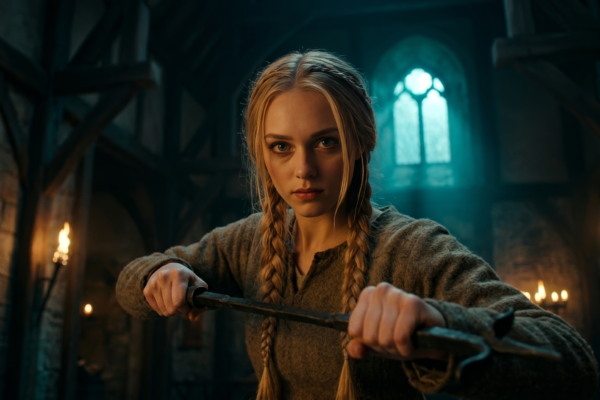
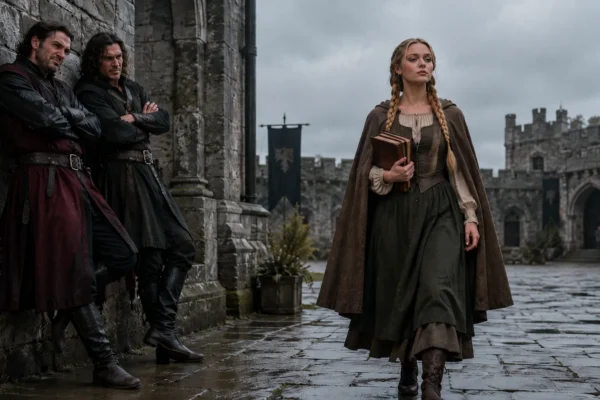
There’s a particular kind of magic that happens in the comment section of a good werewolf narration video. Someone calls the fated-mate reveal four chapters early. Someone else types “NOT the Alpha King doing that 😭” in all caps. A third person has simply transcribed their favorite growled line of dialogue and appended three wolf emojis. It looks like chaos. It is, in fact, a liturgy.
Because that’s not an audience. That’s a congregation.
I’ve spent a lot of my life around books and the people who love them a little too much (professional hazard — more on the librarian thing shortly), and I want to make a claim that will sound completely unhinged for exactly one paragraph before it starts sounding obvious: shifter YouTube is the direct descendant of *The Rocky Horror Picture Show.*
Yes. A 1975 glam-rock musical about a bisexual alien in fishnets, and a modern Lycan romance about a brooding Alpha King who feels his feelings in slow motion. Different species, identical DNA. Both run on high camp, gloriously broad archetypes, plot beats you can see coming from three towns over, and a fanbase that would much rather participate than politely observe. And every single thing casual viewers flag as a *flaw* in shifter content — the cell phones in the castle, the melodrama, the sheer too-much-ness of all of it — is actually the genre doing exactly what it was designed to do.
Let me show you.
Wait, What Even Is “Camp”?
Here’s where I pull rank as a librarian and drop a name: Susan Sontag.
In 1964, Sontag wrote an essay called “Notes on ‘Camp'” — fifty-eight little numbered jottings trying to pin down a sensibility that, up to that point, had mostly lived in a knowing glance between people who Got It. Her rough thesis: camp is a love of artifice and exaggeration. It’s the deliberate embrace of *too much.* Camp has no interest in being understated and tasteful. Camp wants to be a lot, on purpose, with its whole chest.
Now go back and reread the shifter genre’s greatest hits with that in your back pocket. The fated-mate bond that lands like a freight train. Dialogue that is less spoken than *growled.* Shoulders that are, frankly, architecturally implausible. The Alpha King who broods in what I can only describe as 4K. None of that is the genre *failing* to be subtle. Subtlety was never on the guest list. That’s the genre absolutely nailing camp.
And once you see it, you can’t unsee it — which is a gift, because the whole viewing experience gets better. The “why is this so over the top?” complaint quietly dissolves, because the over-the-top part *is* the art. You’re not watching a story that tried for restraint and missed. You’re watching a sensibility that’s more than a century deep, and it’s succeeding.
Cell Phones in the Citadel
Which brings us to the single most reliable comment on any shifter video ever posted: “Why is the Alpha King texting inside a medieval stone fortress?”
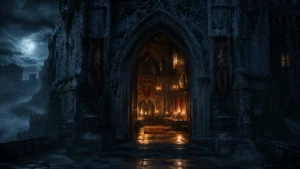 I understand the instinct. I really do. But it’s built on a mix-up, and it’s a fixable one. Viewers see the castle, the cloaks, the swords, and their brain immediately files the whole thing under Medieval Times: Historically Accurate Edition. Then a smartphone appears and the illusion supposedly shatters.
But the castle was never a *timeline.* The castle is a *vibe.*
Here’s my favorite proof, and it’s the exact reason Rocky Horror is the perfect comparison. Picture Frank-N-Furter’s mansion. From the outside: a gothic Frankenstein pile on a lightning-cracked night, every Hammer Horror cliché you could ask for. Now step inside. Fishnets. Glam rock. A laboratory. Actual alien laser beams. Nobody — and I mean *nobody* — has ever watched that film and thought, “hold on, the lasers are a continuity error.” The clash is the point. It’s a deliberate era-mashup, and the audience cheerfully signs the contract in the first five minutes.
Shifter lore works precisely the same way. It’s contemporary urban fantasy wearing a period costume. So of course the Lycan Commander has a phone. If you’re coordinating border security across four hundred miles of howling wilderness, you are not dispatching a carrier pigeon and hoping for the best. The castle is a mood. The phone is a Tuesday. Both are true at the same time, and the genre is completely relaxed about it — which is the correct way to be.
The Time Warp Effect: Why We Love Knowing What Happens Next
Now let’s talk about the part everyone secretly loves the most: knowing exactly what’s about to happen.
At a Rocky Horror midnight screening, the crowd throws rice during the wedding, holds newspapers over their heads when it rains onscreen, shouts callbacks louder than the actual dialogue, and does the Time Warp — a dance so thoroughly, publicly memorized that a hundred strangers perform it in flawless unison. Nobody is confused about the steps. Knowing them is the entire point.
Shifter YouTube runs the identical playbook in a different medium. The comments call the twist before it lands. They quote lines back verbatim. They gatekeep tropes with the tender ferocity of people guarding something sacred. And here’s the thing casual observers get completely backwards: predictability is not a bug in cult media. It’s the cover charge.
You physically cannot do callbacks to a story nobody can anticipate. The familiar beats — the rejection, the reveal, the grovel, the bond — those are the sheet music the entire room is singing from. Knowing what’s coming isn’t what makes it boring. Knowing what’s coming is what lets a thousand strangers show up and perform it *together.* And performing it together is the precise moment a viewer stops being a viewer and becomes a member.
Everyone Deserves a Book (But Not Everyone Wants Yours)
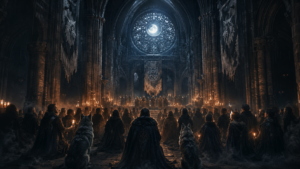 Now, the professional wisdom — because I promised you a librarian, and a librarian delivers.
There’s a golden rule in my world: everyone deserves a book that’s for them. Every reader, somewhere, has a story that fits them like a key in a lock.
But there’s a second half to that rule, and it’s the half that will save your creative sanity: *not everyone is going to want to read your book.* And that is not a failure. That’s curation. That’s the system working exactly as intended.
Rocky Horror is the patron saint of this idea. It did not do well in wide theatrical release. By conventional box-office logic, it was a flop. And then it found its real home — midnight screenings, where the *right* people showed up, in costume, week after week after week, for literal decades. It never needed everyone. It needed the ones who loved it, and it kept them forever.
So if you’re the one making this stuff, you’ve basically got two honest paths. You can be the **Algorithmic Purist** — play the hits, serve the broad self-insert fantasy, chase the clicks. There is zero shame in that; it’s a genuine craft. Or you can be the **World-Builder** — construct a strange, specific, layered universe that maybe pulls smaller numbers but earns a genuinely rabid, cult-level loyalty. Escapism is deeply personal, and self-insert fantasy is intimate by its very nature, which is *exactly* why the people who click with your particular world will click with it so hard. A lower view count was never the same thing as a worse story.
Don’t Dream It, Be It
If you take one thing away from a librarian who has watched an alarming amount of werewolf content in the name of research, let it be this: understanding how cults actually work pulls the sting right out of the algorithm.
A smaller view count doesn’t mean you made something bad. It means you made a cult object — and cult objects find their people slowly, one perfectly-aimed weirdo at a time.
Rocky Horror wasn’t for everyone. That was never the assignment. For the people it *was* for, it became everything they had.
So keep building the strange, specific, unapologetic world only you would ever make. Camp has never once apologized for itself, and neither should you.
Don’t dream it. Be it. And let the cult come find you.